

Gravitational Lensing is one of the result of renowned scientist, Albert Einstein's General theory of Relativity. The mathematical equations of General Relativity suggested that light should distort around massive objects.
But no practical proof was found until astronomer Arthur Eddington observed the phenomena during a total solar eclipse in 1919. He captured the light from a star which was behind the Sun at the moment. According to the General Relativity, light coming from the background star must have distorted due to a wrap in spacetime fabric by the Sun.
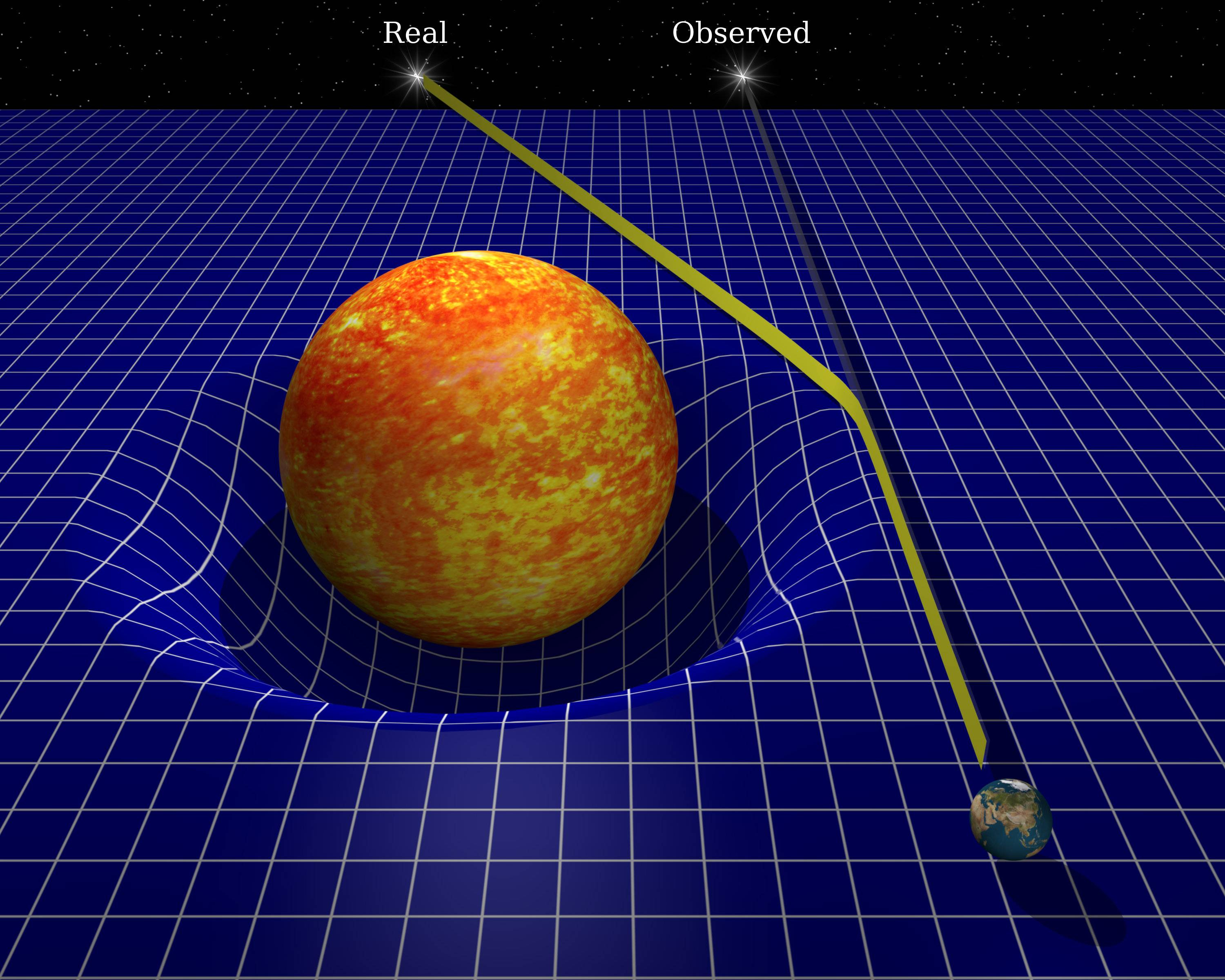
Here, the Sun acts like a huge natural magnifying lens due to its immense gravity. Hence, astronomers call the foreground object as gravitational lens. Any celestial object can act as gravitational lens.
Lensing will be strong if the lens is a strong source of gravity & the background object releases a huge amount of light energy. Addition to this, both the objects should be close to each other & the observer must be at correct distance to view the magnified image of background objects.
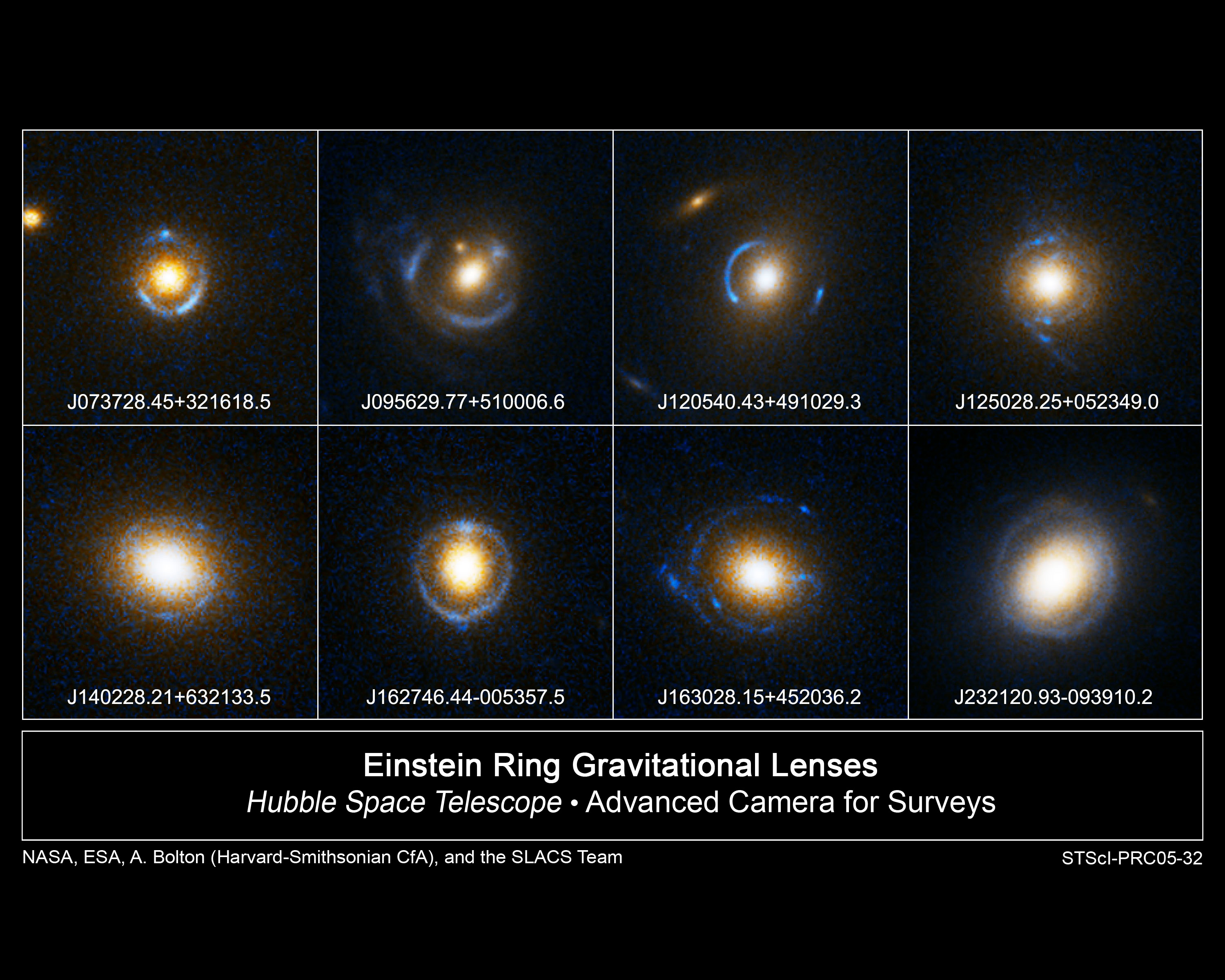
In strong lensing, observer will see multiple images of background object that help confirm the presence of the object. If the light is coming from all the directions & the lens bend the spacetime uniformly, then an Einstein ring is formed around the gravitational lens.
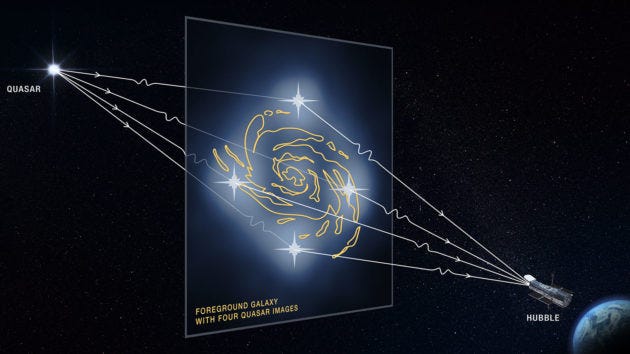
But if both the objects are very massive & are strong source of light, then a very rare Einstein cross is formed by 3-4 bright images of the background object. The Einstein cross is mainly formed by the Quasars, an active supermassive black hole, galaxy clusters, etc…
Since strong lensing require very massive objects, it is a rare phenomena. But smaller bodies also bend the spacetime & hence also produce a weak lensing effect.
As weak lensing distorts the light much less, we cannot see a magnified image of the background galaxy or star. Instead, it introduce the cosmic shear effect by distorting the shapes of galaxies. As a result, we get a stretched, distorted image of background object rather than a magnified one.
Although weak lensing occurs everywhere in the universe, we cannot observe much of them with current technology. But there is yet another effect which we can observe - Microlensing. In Microlensing, the gravitational lens are too small such as a star or an exoplanet.
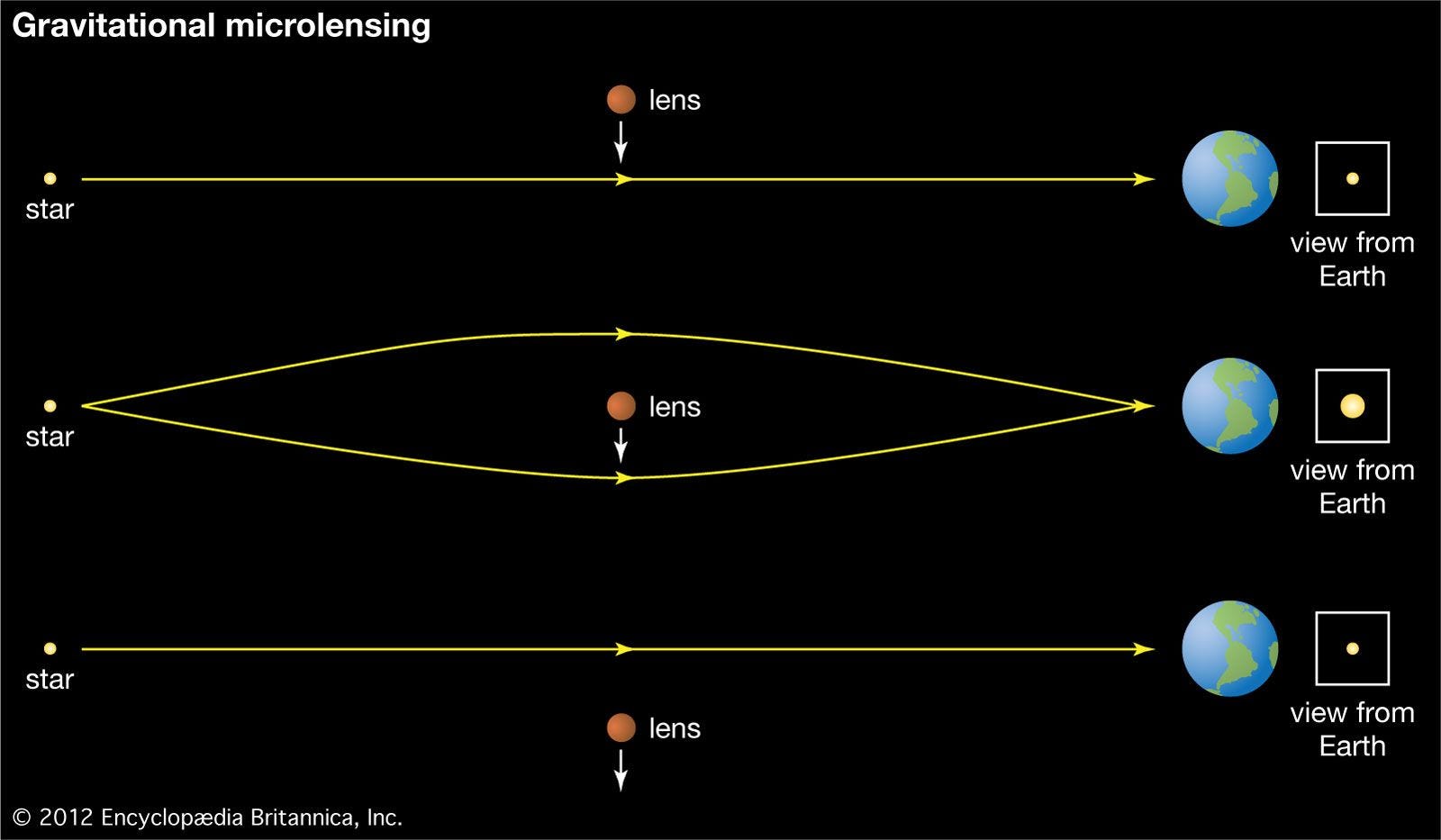
When a background star gets covered by another star or an exoplanet such that the background star looks brighter for some time. In this way, lensing helps astronomers discover new stars which are too faint to detect from current telescopes. Addition to this, they have also discovered many new exoplanets by using Microlensing effect.
Many different projects like the Frontier Fields Program are running to explore the universe by using the Gravitational lensing concept. Under the projects, astronomers examine galaxies, galaxy clusters, measure the distortion in light, predict & calculate the statistical properties of the celestial bodies & try to learn more about cosmology of the universe.
While measuring the mass distribution of galaxies, astronomers came to know that the galaxy clusters are ruled by the dark matter, instead of normal matter. So, gravitational lensing too supports the presence of dark matter in the universe.
Originally published at the ‘National Space Society’
Want Space to be easily accessible to everyone? So, Assist me to continue publishing all of my writes free for everyone…!